
Quick Summary
Effective black mold removal in interconnected New York City properties requires strict containment and prompt moisture control to stop spores from spreading through aging structural assemblies. Wade's Restoration provides comprehensive black mold remediation tailored to NYC architecture, utilizing containment barriers, structural drying, and insurance-ready documentation to eliminate infestations at their root cause. Readers can evaluate standard remediation costs, navigate repair protocols, and contact Wade's Restoration for 24/7 live assistance to schedule a free visual mold inspection.
Black Mold Removal: Fast, Safe Cleanup for NYC Homes
Discovering black mold behind bathroom tile, beneath kitchen subfloors, or along a shared basement wall requires prompt attention. In New York City apartments, row houses, and commercial spaces, moisture can spread quickly through interconnected structures. Wade’s Restoration provides mold remediation services in New York City to help property owners contain contamination and address the underlying moisture source.[2]
Most residential mold remediation projects range from $1,223 to $3,757, with an average cost around $2,368. However, the true scope depends on whether mold is limited to surface drywall or has soaked deep into structural assemblies. If you suspect mold in your property, Wade’s Restoration provides itemized estimates before work begins. See also Flooded Basement Cleanup – Call Now-10% Off – Same-Day Service – Free Estimate.
Black Mold Removal: Response and What to Expect
When dealing with suspected mold, controlling moisture and preventing spread are primary considerations. Mold spores can move through ventilation pathways, pipe cutouts, and unsealed floorboards, making proper containment important during cleanup.[3]
The U.S. Consumer Product Safety Commission states that mold can grow on moist surfaces and that moisture control is the key to prevention. The Centers for Disease Control and Prevention (CDC) maintains current public health information on Stachybotrys chartarum (the species commonly called black mold), noting that damp indoor environments need prompt remediation regardless of the specific mold type. While a 2021 thesis from the University of Memphis found no statistically significant association between environmental mold exposure and reported respiratory symptoms in its sample of 15 homes, containing airborne particles remains essential for indoor air quality and building safety.[1]
Immediate Action Steps When You Spot Suspected Mold
- Do not disturb the growth: Avoid dry-scrubbing or scraping visible colonies, which can release spores into the air.
- Shut down forced-air units: Turn off window AC units or HVAC systems serving the affected room to reduce air circulation.
- Isolate the room: Close interior doors to help prevent spores from spreading to adjoining living areas.
- Stop the water supply: If the mold stems from an active plumbing leak or drip, shut off the local water valve.
- Contact a professional: Reach out to Wade’s Restoration to assist with containment, moisture control, and remediation.
What Does Black Mold Removal Cost?
Every building presents unique structural challenges, especially older NYC walk-ups and row houses. Professional mold remediation typically costs between $1,223 and $3,757. Small, contained jobs on modern drywall fall on the lower end, while jobs requiring removal of saturated building materials reach higher price points.
Standard Cost Table by Restoration Scope
| Restoration Service Scope | Estimated Cost Range |
|---|---|
| Inspection & Moisture Assessment | $150 – $500 |
| Water Extraction & Structural Drying (per room) | $1,200 – $4,500 |
| Mold Remediation (Standard Range) | $1,223 – $3,757 (Typical: $2,368) |
| Sewage Backup Cleanup & Sanitization | $2,000 – $10,000 |
| Full Water Damage Restoration (Typical Claim) | $3,000 – $15,000 |
| Structural Masonry & Joist Restoration | $3,500 – $12,000+ |
Note: Individual property conditions dictate final pricing. The scope written is the scope billed – call for an exact quote.
Key Factors That Drive Remediation Expenses
- Material Porosity: Non-porous materials can often be cleaned on-site, whereas porous materials like drywall or insulation that are extensively damaged may need removal.
- Containment Requirements: Using plastic containment barriers for larger areas helps protect unaffected rooms and adjoining units.
- Moisture Source and Drying: Thoroughly drying framing, subflooring, or masonry to resolve the moisture issue is necessary to complete remediation.
Navigating Insurance Coverage
Homeowners insurance coverage for mold is policy-specific and often restricted. Coverage depends strictly on the specific policy terms and exclusions. Property owners should review their individual policies to determine what coverage may apply.
Wade’s Restoration provides documentation and itemized scopes to assist property owners during the claims review process.
Structural Considerations: Drywall, Joists, and Masonry
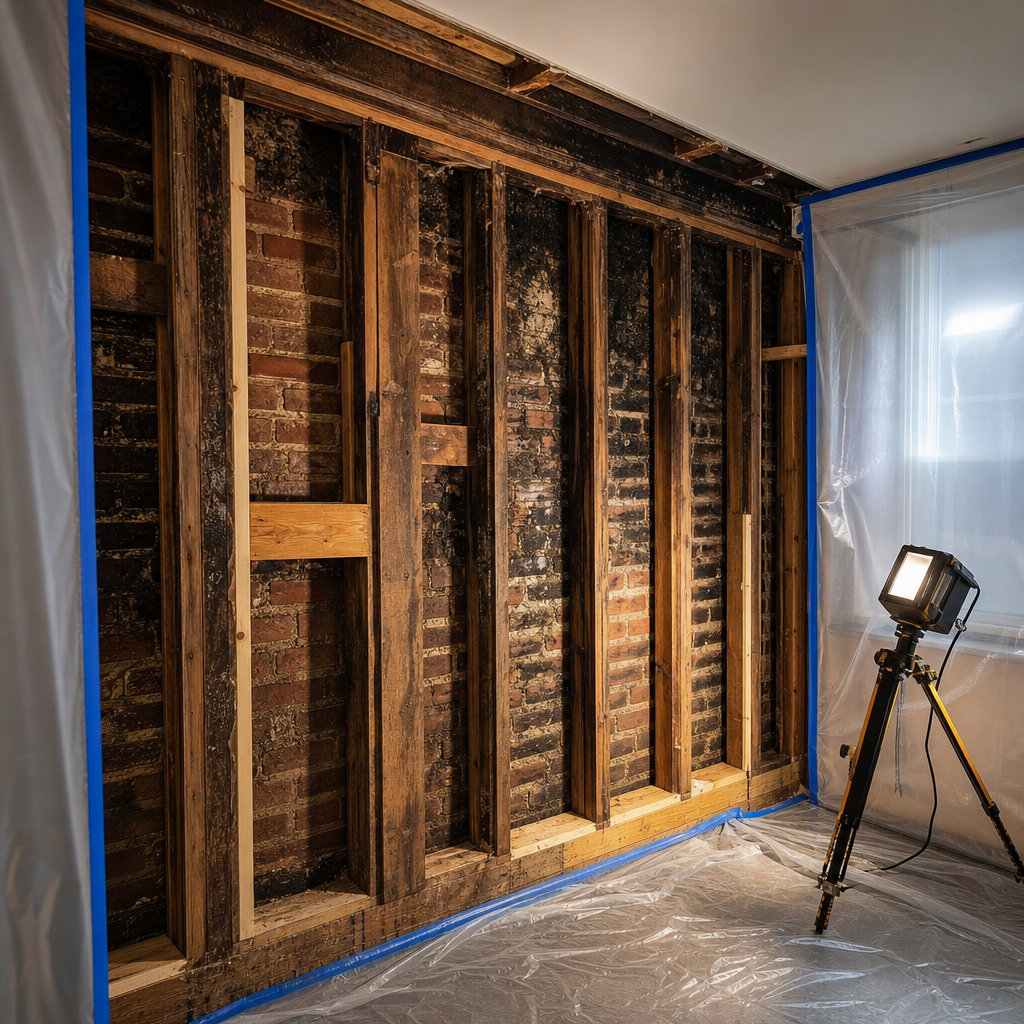
In multi-family and pre-war structures, moisture can wick into plaster, brick, and heavy timber. According to Wade’s Restoration, proper remediation requires identifying the source of water intrusion, containing the work area for larger contamination, and ensuring that structural components are completely dried according to general EPA cleanup guidance.
Repair vs. Replace Decision Matrix
| Structural Material | General Remediation Guidance |
|---|---|
| Drywall & Porous Materials | Porous materials with extensive mold damage generally need to be removed, discarded, and replaced. |
| Hard Surfaces & Non-Porous Materials | Can typically be cleaned with detergent and water, followed by complete drying. |
| Structural Masonry & Timber | Requires resolving moisture intrusion, cleaning surfaces, and thorough structural drying. |
General Mold Remediation Procedures
In accordance with general EPA cleanup guidance, professional mold remediation centers on moisture control, containment for larger jobs, and thorough cleaning:
- Moisture Control: The first and most critical step is identifying and repairing the water or moisture problem, as mold cannot continue growing without moisture.
- Containment for Larger Jobs: For larger areas of contamination, containment barriers are set up to prevent mold spores from spreading into unaffected living spaces.
- Cleaning and Material Removal: Mold on hard surfaces is cleaned with detergent and water. Heavily contaminated porous materials that cannot be cleaned must be removed and discarded.
- Thorough Drying: All cleaned surfaces and structural materials must be dried completely to prevent mold from returning.
DIY Cleanup vs. Professional Remediation
| Scope | Recommended Approach |
|---|---|
| Small Mold Problems on Hard Surfaces | Can be cleaned with detergent and water, then dried completely. |
| Larger Mold Problems & Hidden Moisture | Requires containment, moisture source repair, and thorough structural drying following EPA guidance. |
Frequently Asked Questions About Mold Remediation
How much does professional mold removal cost?
Professional mold remediation generally costs between $1,223 and $3,757, with an average around $2,368. Costs vary depending on the square footage affected, material porosity, and containment needs.
Is it safe to remove mold yourself or should you hire a professional?
Small mold problems on hard surfaces can be cleaned with detergent and water and dried completely. For larger cleanup jobs or extensive moisture issues, containment and professional remediation are recommended.[4]
Does homeowners insurance cover black mold remediation?
Insurance coverage for mold remediation is policy-specific and often restricted. Property owners should consult their specific policy terms to determine if mold cleanup is covered under their plan.
What does the CDC state regarding Stachybotrys chartarum (black mold)?
The Centers for Disease Control and Prevention (CDC) notes that all molds in damp indoor environments should be remediated promptly, regardless of whether the species is Stachybotrys chartarum or another type, with moisture control being the key to prevention.[5]
How long does the mold cleanup process take?
The duration depends on the extent of the mold growth and the time required to resolve the moisture problem and thoroughly dry all affected materials according to general EPA guidance.
Can residents remain in the building during remediation?
For small, isolated cleanup areas, occupants can often remain in the building. For larger jobs involving extensive containment, occupants may choose to stay out of the work area until cleaning and drying are complete.
Sources
- Respiratory Diseases in University Students Associated with Exposure to Residential Dampness or Mold – PubMed – pubmed.ncbi.nlm.nih.gov (2097)
- Evaluation of Indoor Dampness, Mold, and Ventilation at a College … – stacks.cdc.gov (2025)
- NIOSH Health Hazard Evaluation Report 2022-0077-3422 – cdc.gov (2025)
- Indoor dampness and mould health effects – PMC – NIH – pmc.ncbi.nlm.nih.gov (2007)
- A Brief Guide to Mold, Moisture and Your Home – epa.gov
Frequently Asked Questions
How do specialists detect hidden black mold behind NYC plaster walls and pre-war masonry?
Specialists use advanced moisture mapping and thermal imaging to pinpoint dampness trapped behind dense plaster, brick, and subflooring. Wade's Restoration provides 24/7 live assistance to schedule a free visual mold inspection, identifying hidden infestations in older building assemblies at their root source.
What documentation is needed to support an insurance claim for black mold removal?
Insurers typically require photographic evidence, moisture logs, and an itemized restoration scope proving the mold resulted from a covered water intrusion event. Wade's Restoration prepares comprehensive, insurance-ready documentation to help property owners navigate the claims review process efficiently.
How does professional containment prevent black mold from spreading through shared apartment walls?
Remediation teams seal the affected area with heavy-duty plastic barriers and operate HEPA-filtered negative air machines to capture airborne spores. Wade's Restoration tailors these containment protocols specifically to NYC multi-family buildings, isolating shared ventilation shafts, pipe cutouts, and unsealed floorboards.
About the author
 |
David Harrison David Harrison is a certified water damage restoration technician with over 8 years of experience in the field. He holds a degree in Construction Management from Pratt Institute and specializes in providing practical advice for navigating property emergencies and insurance claims. |
Water damage, flood, or mold emergency?
We’re available now - call for a fast, free estimate.
Call Now - Free Estimate