
Quick Summary
Learning how to safely remove black mold requires isolating the work area and wearing proper protective equipment to prevent hazardous spores from dispersing throughout your home. Remediation specialists at Wade's Restoration emphasize that true safety depends on physically removing contaminated porous materials, damp-cleaning hard surfaces, and resolving the underlying moisture source. After reading, property owners will understand proper containment protocols and know when to schedule a professional visual inspection and moisture assessment for hazardous structural infestations.
How to Safely Remove Mold Without Spreading Spores
If you have spotted mold patches spreading across baseboards or behind a wall, your first instinct may be to grab a bottle of cleaner and a scrub brush. However, dry-scrubbing or improper cleaning can disturb mold colonies and release spores into the air, allowing them to spread to other areas of the building. Mold should be removed regardless of the type, and routine mold testing is generally not recommended because testing results cannot reliably predict illness.
As specialists at Wade’s Restoration note, safely cleaning up visible mold requires isolating the work area, using appropriate personal protection, physically removing contaminated materials that cannot be salvaged, and correcting the underlying moisture source. For localized cleanups on hard materials, specific safety practices can help you clean effectively while minimizing the spread of airborne dust and spores.[5] See also Flooded Basement Cleanup – Call Now-10% Off – Same-Day Service – Free Estimate.
What You Need to Know Before Removing Mold
Cleaning up mold after leaks or flooding can create health and injury risks because disturbing growth can disperse spores and dust into the surrounding air.
In some people, mold exposure can cause or contribute to a stuffy nose, sore throat, coughing, wheezing, burning eyes, and skin rash. There is sufficient evidence of association between indoor mold exposure and upper respiratory symptoms, cough, and wheezing in otherwise healthy people, asthma symptoms in people with asthma, and hypersensitivity pneumonitis in susceptible individuals.
You do not need to perform routine mold testing before taking action. Mold should be removed regardless of the species, and testing is generally not recommended because results do not reliably predict health effects. If visible mold is present or you detect musty odors, the priority should be physical removal and moisture correction.
Important Health Warning: People who are immunosuppressed should avoid contaminated buildings and should not perform mold cleanup activities.[2]
Essential PPE Checklist
Protective equipment helps reduce exposure to airborne particles and cleaning agents during cleanup.
- Respiratory Protection: Wear at least a NIOSH-approved N95 respirator for small cleanups.
- Eye Protection: Wear protective goggles to shield your eyes from spores and cleaning solutions.
- Protective Gloves: Wear protective gloves to prevent skin contact with mold and cleaning products.
Additional protective equipment or professional remediation help should be used for larger or more hazardous cleanup work.
When to Seek Professional Remediation
You should consider seeking professional help rather than attempting cleanup yourself if you encounter:
- Larger areas of mold growth.
- Extensive water damage.
- HVAC system involvement.
- Substantial porous-material contamination.
- Occupants with asthma, allergies, immune suppression, or other health risks.
Step 1: Isolate the Work Area
Containment helps prevent airborne dust and mold spores from spreading into unaffected areas of the building.
- Turn Off the HVAC System: Keep heating, ventilation, and air conditioning systems turned off when contamination may involve the system to avoid spreading spores through ductwork.
- Isolate the Area: Isolate the work area and close off interior doorways and openings to adjacent rooms.
- Avoid Unnecessary Disturbance: Avoid unnecessary disturbance of moldy materials to limit the release of airborne dust and spores.
Step 2: Control Airflow and Ventilation
Ventilate safely when using cleaning products by providing fresh outdoor air where appropriate, while avoiding air currents that blow directly across dry mold colonies and spread spores into clean living spaces.[3]
Step 3: Clean Surfaces and Control Moisture
According to Wade’s Restoration, physical removal of mold and moisture correction are essential. Simply killing mold is not enough because dead mold can still cause allergic reactions.
Cleaning Hard Surfaces
Hard, nonporous surfaces should first be cleaned with soap or dish detergent and water, and then dried thoroughly.
If bleach is used, the CDC permits a solution of no more than 1 cup of household bleach per gallon of water for suitable hard surfaces. Always ensure adequate ventilation, follow product label instructions, and never mix bleach with ammonia or other cleaners, as this produces hazardous gases.[1]
Proper Cleaning Practices
- Damp-Clean Surfaces: Wipe hard surfaces with damp cloths and detergent solutions rather than dry-sweeping or dry-wiping, which can stir up dust.
- Dry Thoroughly: Ensure all cleaned surfaces are dried completely after washing.
Step 4: Address Contaminated Porous Materials
Need how to safely remove black mold?
We’re available now - call for a fast, free estimate.
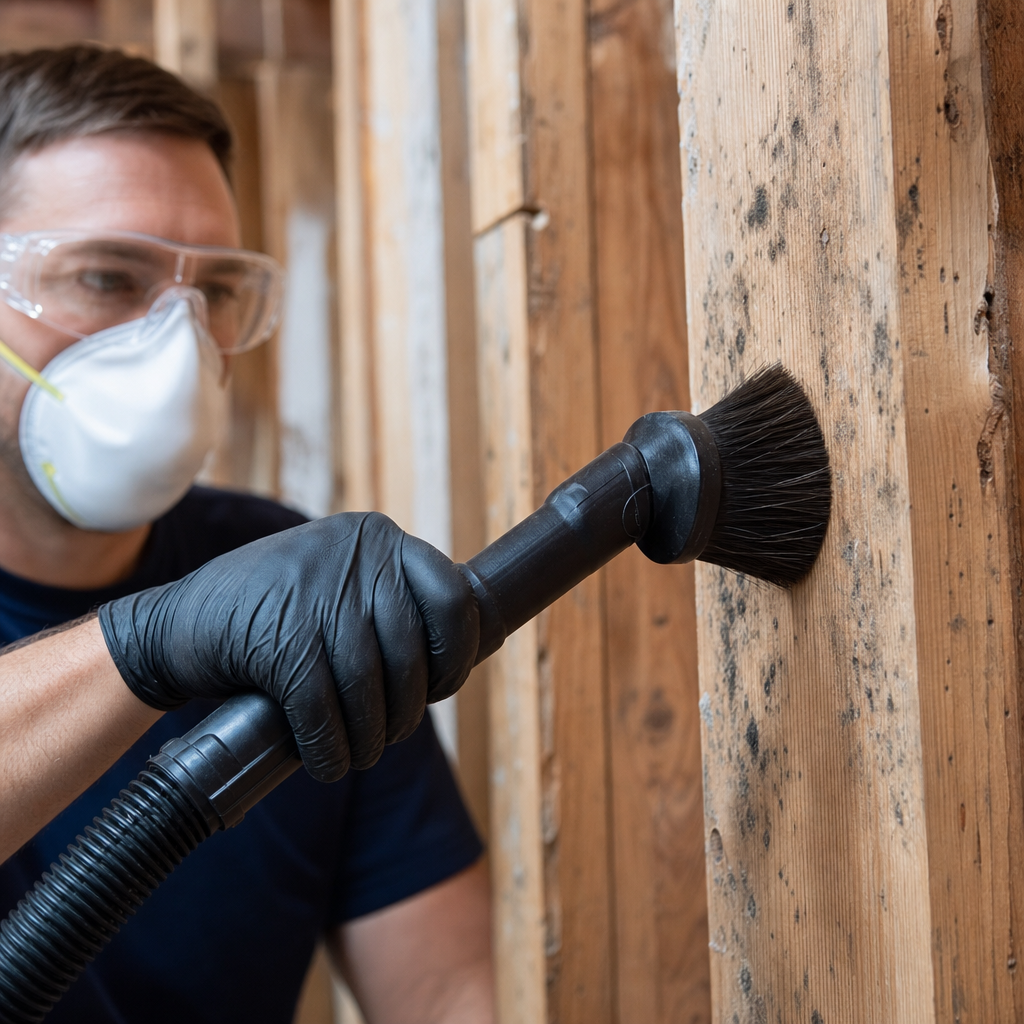
Porous materials that have absorbed moisture and sustained substantial mold contamination may not be effectively cleaned. Items such as saturated drywall, insulation, and ceiling tiles should be carefully removed and discarded to eliminate the mold reservoir, taking care to minimize airborne dust during removal.[4]
Step 5: Clean Exposed Structural Elements
When structural framing is exposed during the removal of damaged finishes, surfaces should be physically cleaned with detergent and water or appropriate cleaning solutions, and allowed to dry completely. Emphasize physical removal of the growth rather than relying solely on chemical treatments.
Step 6: Eliminate Underlying Moisture
Mold cannot grow without moisture. Identifying and fixing the underlying water problem – whether a plumbing leak, roof failure, groundwater intrusion, or high indoor humidity – is necessary to prevent mold from returning.
Managing Mold in Critical Components: Walls, Subfloors, and Ducts
Different materials require different management strategies:
- Nonporous and Semi-Porous Materials: Intact hard surfaces can typically be cleaned with detergent and water and dried thoroughly.
- Substantially Damaged Porous Items: Materials with deep contamination should be removed and replaced.
- HVAC Systems: If mold contamination involves the HVAC system, keep the system turned off and seek professional assistance to properly address the equipment and ductwork.
Frequently Asked Questions
Why is routine mold testing not recommended?
Routine mold testing is generally not recommended because testing results cannot reliably predict illness. If visible mold or moisture damage is present, resources are best directed toward removing the mold and fixing the moisture problem.
Can dead mold still cause health symptoms?
Yes. Dead mold can still cause allergic reactions and respiratory symptoms. This is why teams at Wade’s Restoration emphasize that mold must be physically removed from surfaces rather than merely treated with chemicals or disinfectants.
What should be used to clean hard surfaces?
Hard, nonporous surfaces should first be cleaned thoroughly with soap or dish detergent and water, then dried completely. If bleach is chosen for suitable hard surfaces, use no more than 1 cup of household bleach per gallon of water, ensure proper ventilation, follow label instructions, and never mix bleach with ammonia or other cleaning chemicals.
Need how to safely remove black mold?
We’re available now - call for a fast, free estimate.
Sources
- Mold clean-up practices vary by sociodemographic and allergy factors – stacks.cdc.gov (2019)
- Morbidity and Mortality Weekly Report, Volume 68, Issue … – cdc.gov (2017)
- NYS Tox Mold Task Force Final Report, December 2010 – health.ny.gov (2010)
- Details: – stacks.cdc.gov (2005)
- Invasive mold infections in immunocompromised people – stacks.cdc.gov (2019)
Related reading: Best Way to Remove Water From Basement – 10% Off & Free Estimate – Same-Day Service
Related reading: Can I Clean Black Mold Myself – 10% Off & Free Estimate – Same-Day Service
Related reading: Flood Damage Insurance Claim – 10% Off & Free Estimate – Same-Day Service
Frequently Asked Questions
How do I know if black mold has spread behind drywall or under flooring?
Persistent musty odors, recurring water stains, or high indoor humidity often indicate hidden mold colonies inside wall cavities and subfloors. Wade's Restoration recommends scheduling a professional visual inspection and thermal moisture assessment to locate concealed dampness without tearing open materials and dispersing spores.
How should contaminated porous materials be discarded without spreading spores?
Saturated porous items like drywall and insulation should be lightly misted with water to suppress airborne dust and double-bagged inside heavy-duty plastic bags within the isolated work area. Always wipe down the exterior of the sealed bags before carrying them through unaffected living areas for disposal.
How much black mold can I safely clean on my own before needing professional help?
Property owners can typically manage small, localized surface mold covering less than 10 square feet on nonporous surfaces using basic protective equipment and detergent. If the mold spans larger areas, affects HVAC ductwork, or penetrates structural framing, certified specialists like Wade's Restoration should establish full containment to remove it safely.
About the author
 |
David Harrison David Harrison is a certified water damage restoration technician with over 8 years of experience in the field. He holds a degree in Construction Management from Pratt Institute and specializes in providing practical advice for navigating property emergencies and insurance claims. |
Water damage, flood, or mold emergency?
We’re available now - call for a fast, free estimate.
Call Now - Free Estimate