
Quick Summary
When sudden disasters strike, immediate emergency water and fire restoration is critical to prevent pervasive mold growth, soot staining, and severe structural degradation. Wade's Restoration delivers a seamless, single-source recovery solution by managing rapid water extraction, soot removal, full structural rebuilds, and direct insurance claims assistance. Readers can effectively navigate disaster recovery protocols and call Wade's Restoration 24/7 emergency dispatch line for a 45-minute arrival and a free visual inspection.
Emergency Water and Fire Restoration: Rapid Response Services
When fire sprinklers activate, a supply line breaks, or water is used to extinguish a blaze, water and smoke can quickly damage property. Water can affect structural wood, plaster, and building materials, and mold may develop over time in damp conditions. Soot can also stain surfaces and fixtures. Professional emergency water and fire restoration helps mitigate secondary damage through water extraction, drying, soot removal, and structural repairs.[5]
According to the National Fire Protection Association (NFPA), fire departments across the United States responded to an estimated 1,388,000 total fires and $19.1 billion in direct property damage in 2024. While fire statistics quantify direct fire losses, emergency water damage statistics require separate reporting systems and are tracked independently. In structure fires, water used during suppression can potentially cause additional damage, soaking into subfloors, ceiling cavities, and framing.[1]
According to company claims, Wade’s Restoration provides 24/7 emergency dispatch throughout Astoria, Queens, and Lower Manhattan, sending certified technicians directly to the site. The company also states that it handles both mitigation and reconstruction in-house without passing work to third-party contractors to protect buildings and streamline insurance claims (separate evidence should be obtained for these company-provided claims).
How Fast Can Emergency Water and Fire Restoration Save Your Property
Timely action is critical when managing water intrusion and fire residue. Standing water can spread across floorboards and seep into lower levels, softening drywall and swelling wood framing, while smoke and soot can stain surfaces. In moist environments, mold growth can also become a concern over time.
Prompt mitigation focuses on extracting standing water, removing soot and smoke residue, and drying affected materials.
Immediate Steps and Safety Guidance
Property owners should observe key safety protocols before and during cleanup:
- Prioritize safety and evacuation: Evacuate after a fire, call emergency services when needed, and do not re-enter the property until officials determine it is safe to do so.
- Shut off utilities only when safe: If safe to do so, shut off the water main during plumbing emergencies, or switch off circuit breakers for affected rooms. Avoid unsafe electrical systems and do not enter areas with standing water to access electrical panels.
- Avoid contaminated water: Do not come into direct contact with standing water that may be contaminated.
- Document damage and report promptly: Take photos and document damage for insurance purposes, and report the loss promptly to your insurance company.
- Protect surfaces and systems: Keep HVAC systems off to avoid circulating soot particulates, and avoid dry-wiping soot from walls and furnishings to prevent deeper staining.
Initial Restoration Steps on Site
According to standard restoration procedures, technicians use moisture meters and thermal imaging to evaluate hidden water pathways. Restoration crews typically extract standing water, contain affected areas, and use dehumidification and air filtration equipment to stabilize the indoor environment.
Critical Property Components: Drywall, Joists, and Party Walls
Need emergency water and fire restoration?
We’re available now - call for a fast, free estimate.
Restoring older properties requires consideration of regional construction styles, such as pre-war brick buildings and attached row houses, which may respond differently to water and smoke than modern construction.
Drywall, Ceilings, and Plaster
Drywall and plaster materials can degrade when exposed to standing water or high moisture levels, often requiring repair or replacement depending on the extent of saturation.
According to NFPA reporting, nearly one-quarter of U.S. fires in 2024 occurred in home properties, including one- and two-family homes and apartments or other multifamily housing, and structural fires accounted for 470,500 structure fires and $15.3 billion in direct property damage nationwide. Water runoff from fire suppression can create additional challenges for building assemblies.[2]
Subfloors and Timber Joist Saturation
Water accumulation from fire suppression or plumbing failures can saturate subflooring and framing joists. Restoration assessments, such as those conducted by Wade’s Restoration, typically involve checking moisture levels, inspecting for trapped moisture behind flooring, and evaluating framing condition to determine appropriate drying or structural repair steps.
Shared Party Walls in Pre-War Buildings
In attached row houses and pre-war apartment buildings, properties often share brick or timber party walls. Restoration work in these structures requires careful containment and drying practices to prevent moisture, soot, and smoke odors from spreading into neighboring living spaces.
Mitigation vs. Full Restoration: Comparing the Disaster Recovery Process
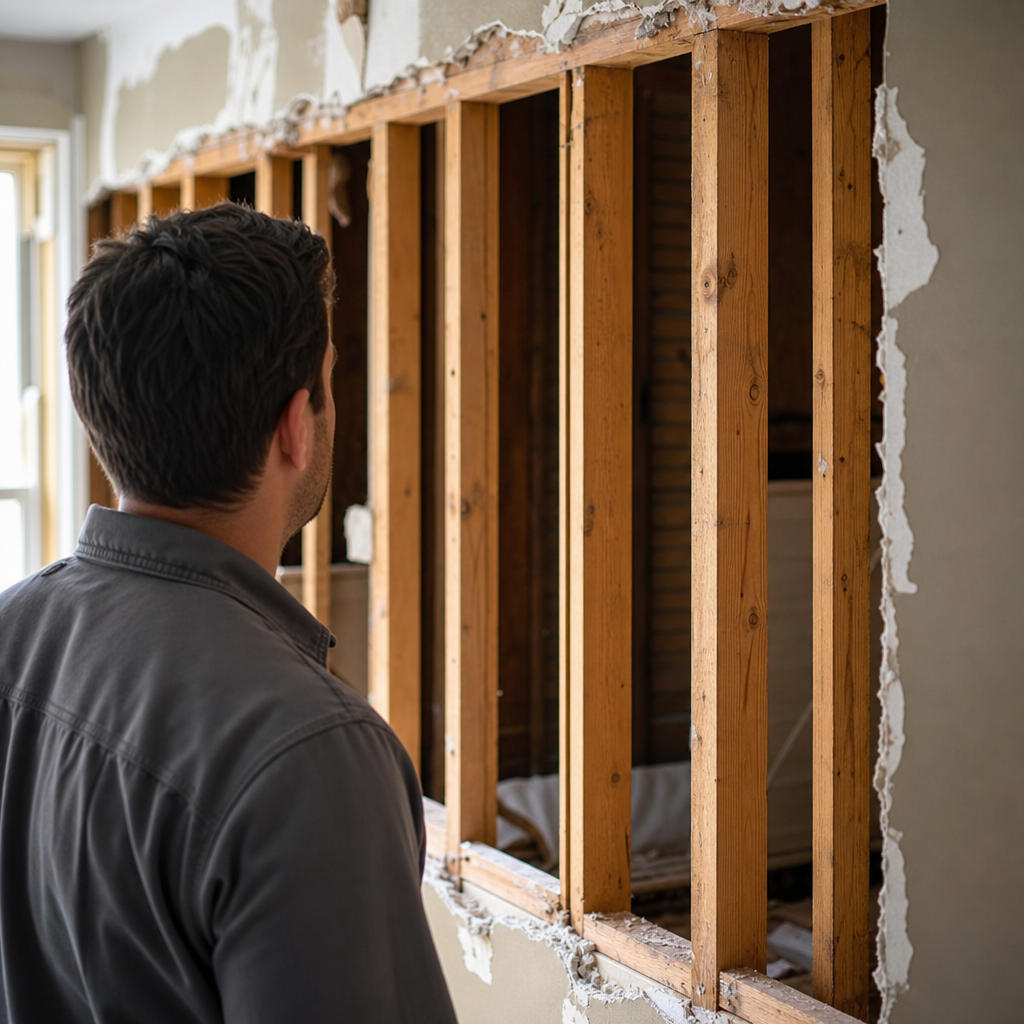
Property recovery takes place in two distinct phases: mitigation and restoration. Understanding the difference helps property owners set expectations and manage timelines during an emergency.
Phase 1: Emergency Mitigation and Hazard Containment
Mitigation focuses on stopping active damage, securing the building, and stabilizing the interior environment:
- Emergency Board-Up and Roof Tarping: Securing broken windows, doors, and damaged roofs to protect against weather and unauthorized entry.
- Water Extraction and Pump-Out: Removing standing water from basements, crawlspaces, and living areas.
- Material Removal: Removing unsalvageable, soaked drywall, insulation, and charred materials to facilitate drying.
- Environmental Stabilization: Running dehumidification and air filtration equipment to dry framing and address smoke odor.
Phase 2: Complete Structural Rebuild and Deodorization
Once moisture levels in structural materials return to acceptable levels, the restoration phase begins. This phase returns the property to its pre-loss condition through framing repairs, new drywall installation, subfloor repairs, electrical work, and finish painting.
Contractor Service Models
Residential fires remain a major source of property loss, with approximately $11.56 billion in residential building fire losses recorded in 2024. When dealing with significant property losses, contractor models can differ.[3]
| Feature | Single-Source Direct Model (Company-Claimed Model for Wade’s Restoration) | Subcontractor Networks | Independent Trades |
|---|---|---|---|
| Accountability | Company claims one dedicated project manager oversees cleanup through rebuild | Work passed between separate mitigation and construction companies | Property owner must hire and supervise separate plumbers, framers, and painters |
| Project Handoffs | Company claims minimal downtime between drying and reconstruction | Delays while new contractors quote and schedule the rebuild | Constant scheduling conflicts between independent crews |
| Insurance Documentation | Company claims unified moisture logs and estimates are provided directly to adjusters | Disjointed estimates and conflicting scopes sent to adjusters | Multiple separate invoices that adjusters often dispute |
What Does Emergency Water and Fire Restoration Cost?
Need emergency water and fire restoration?
We’re available now - call for a fast, free estimate.
Water damage repair estimates may be about $3 to $7.50 per square foot, with one cited estimate averaging approximately $8,046 and ranging from $2,700 to $14,730. Fire damage restoration costs also vary depending on the extent of structural damage, soot contamination, and rebuilding requirements. Costs vary based on project specifics and are not guaranteed.[4]
Key Factors That Drive Cleanup Pricing
Several factors dictate the final cost of an emergency project:
- Water Contamination Source: Clean water from supply lines generally requires less specialized handling than water containing contaminants or sewage backups.
- Building Age and Materials: Older structures with historic materials may require additional labor and specialized drying methods compared to standard drywall construction.
- Extent of Fire and Smoke Damage: Heavy soot and deep charring require more intensive cleaning, deodorization, and structural rebuilding.
Navigating Insurance Claims and Carrier Approvals
Insurance coverage depends on the cause of loss, policy terms, exclusions, coverage limits, and deductibles. Standard property insurance policies may cover fire damage and certain sudden and accidental water damage (such as burst pipes). However, flood damage from rising outdoor water generally requires separate flood insurance (such as through the National Flood Insurance Program), and sewer backups may require specific optional endorsements.
According to company claims, Wade’s Restoration assists property owners by working with adjusters through its Claim Clarity Program, providing photo documentation, moisture logs, and itemized estimates. Separate evidence should be obtained to evaluate these company-provided claims.
Frequently Asked Questions About Disaster Cleanup in Astoria and NYC
How much does emergency restoration cost in Astoria and NYC?
Water damage repair estimates may range from approximately $3 to $7.50 per square foot, with average costs reported around $8,046 (ranging from $2,700 to $14,730). Overall restoration costs vary significantly depending on square footage, materials involved, and the extent of water or fire damage, and costs are not guaranteed.
How quickly can a restoration crew respond to water or fire damage?
Response time depends on provider, location, access, damage severity, and current demand. Contact the restoration company and insurer promptly after making the property safe.
Does homeowners insurance cover emergency water and fire restoration?
Coverage depends on the cause, policy terms, exclusions, limits, and deductible. Fire damage and certain sudden, accidental water damage events are often covered under standard homeowner policies, while flood damage generally requires separate flood insurance, and sewer backups may require specific endorsements.
How do professionals remove smoke odor and water damage simultaneously?
Restoration teams address water and smoke damage concurrently by extracting standing water, operating commercial dehumidifiers and air scrubbers, and applying appropriate cleaning and deodorization methods across affected areas.
To address water and fire damage, property owners can contact Wade’s Restoration to inquire about its company-claimed 24/7 emergency dispatch services and on-site assessments.
Need emergency water and fire restoration?
We’re available now - call for a fast, free estimate.
Sources
- Statistics – USFA.FEMA.gov – usfa.fema.gov (2024)
- Residential fire estimate summaries (2014-2023) – USFA.FEMA.gov – usfa.fema.gov (2024)
- Department of Public Safety Division of Fire and Life Safety – dps.alaska.gov (2024)
- Residential building fire dollar-loss causes (2014-2023) – usfa.fema.gov (2023)
- 55 Commercial Fire Statistics for 2026 (Data + Sources) – getsafeandsound.com (2026)
Frequently Asked Questions
What happens during Wade's Restoration's initial 45-minute emergency response arrival?
Upon arriving within 45 minutes of your 24/7 call, Wade's Restoration performs a free visual inspection using moisture meters and thermal imaging to map hidden damage. Technicians immediately secure the structure, establish containment, and begin emergency water extraction to stabilize your property.
Can Wade's Restoration handle both disaster mitigation and full structural reconstruction?
Yes, Wade's Restoration operates an in-house, single-source recovery model covering emergency water extraction, soot removal, and complete structural rebuilds. This eliminates handoff delays between separate contractors and provides you with a single point of accountability throughout the entire process.
How does Wade's Restoration assist with property insurance claims during emergency restoration?
Through its Claim Clarity Program, Wade's Restoration works directly with your insurance adjuster by providing unified itemized estimates, moisture logs, and detailed photo documentation. This comprehensive proof helps prevent claim disputes and speeds up approvals for covered water and fire losses.
About the author
 |
Sarah Miller Sarah Miller is a certified water damage restoration specialist with over eight years of experience helping property owners navigate the complexities of mitigation and recovery. She holds an associate degree in Construction Management from New York City College of Technology and has extensive knowledge of local building codes and insurance claim procedures. Through her writing, Sarah provides actionable advice to help property managers and homeowners in the Astoria area understand the true costs and critical steps involved in emergency water damage restoration. |
Water damage, flood, or mold emergency?
We’re available now - call for a fast, free estimate.
Call Now - Free Estimate