
Quick Summary
When moisture breaches wall cavities, timely water damaged drywall repair requires acting within 24 to 48 hours to prevent structural degradation, hidden framing rot, and mold growth. Wade's Restoration provides complete mitigation and reconstruction by using thermal imaging cameras to ensure trapped moisture inside wall cavities is thoroughly eliminated before installing new drywall. Homeowners will learn how to evaluate wall saturation risks and can call Wade's Restoration for a free visual inspection and thermal moisture assessment.
Water Damaged Drywall Repair: Fast Full Recovery Guide
When drywall gets wet, the clock starts immediately. Wet or damp materials should be dried within 24 to 48 hours to reduce mold risk. Drywall that has been wet for more than 48 hours is commonly recommended for replacement. While basic sheetrock replacement might look simple on paper, moisture trapped behind the wall creates deeper issues. Saturated gypsum loses structural integrity fast, locking dampness against insulation, wood studs, and masonry.
Professional restoration handles the recovery process from initial mitigation through final reconstruction. In older walk-ups and attached row houses, water travels quickly along brick party walls and pipe chases, meaning surface-level patches often hide active dampness. Technicians at Wade’s Restoration can use infrared thermal cameras to verify that framing cavities are dry before hanging new board. See also Water Damage Restoration Cost – Call Now-10% Off – Same-Day Service – Free Estimate.
Fast Water Damaged Drywall Repair: Can It Be Saved or Replaced?
Quick Assessment Guide: Category 1 (clean) water damage can often be dried in place if drying begins promptly. Drywall exposed to significant moisture, core saturation, or contaminated water is often evaluated for removal to protect indoor air quality and structural safety.
Deciding whether wet gypsum board can be restored depends on three factors: saturation depth, the cleanliness of the water source, and how quickly drying begins. Drywall may feel dry on the surface after a few hours of fan exposure, but water held within the porous gypsum core breaks down the panel’s binders and creates an environment for mold growth.
| Decision Criteria | Category 1 (Clean Water) | Category 2 (Gray Water) | Category 3 (Black / Sewage) |
|---|---|---|---|
| Under 48 Hours Saturation | Dry in place possible if drying progresses | Removal often recommended | Removal generally recommended |
| Over 48 Hours Saturation | Replacement commonly recommended | Replacement commonly recommended | Replacement commonly recommended |
| Pre-War Brick Wall Impact | Thermal check required | Cavity inspection and drying | Full cavity inspection and drying |
The 48-Hour Decision Window
When clean water from a broken supply line or sink overflow saturates drywall, restoration technicians monitor the material closely. If drying equipment is installed quickly and moisture readings drop steadily without any signs of microbial growth or structural sagging, saving the drywall is possible. Drywall that has been wet for more than 48 hours is commonly recommended for replacement because the gypsum core softens and paper facers may support mold.
Assessing Water Category: Clean vs. Contaminated
Water source determines safety. Category 2 water (such as washing machine discharge or dishwasher overflow) and Category 3 water (sewage backups, ground floodwaters, or toilet overflows) carry contaminants. Depending on the extent of contamination and saturation, removing affected drywall is often recommended to ensure health and structural standards. Opening saturated wall cavities also allows trapped water behind plaster or masonry to drain freely so framing can dry before reconstruction starts.
Water Damaged Drywall and Ceilings: Hidden Risks in Pre-War Buildings
Need water damaged drywall repair?
We’re available now - call for a fast, free estimate.
Pre-war homes, brick walk-ups, and brownstones present distinct moisture challenges. Plaster-on-brick party walls and wood lath act like sponges, wicking moisture sideways between adjoining apartments and row houses. If a repair is performed without addressing moisture trapped in brickwork or structural joists, hidden decay can develop behind freshly painted walls.
Why Standard 12-Inch Flood Cuts Fail on Brick Party Walls
In standard construction, a flood cut removes the damaged drywall above the water line. In older properties, water often migrates vertically and horizontally through shared brick party walls and hollow plumbing chases. When water enters a lath-and-plaster assembly, it can travel along wood slats beyond the original leak point.[2]
Drywall repair requires cutting back materials until dry framing is reached. Skipping moisture verification inside masonry party walls can lead to recurring moisture issues, persistent musty odors, and failing paint. During property restoration, Wade’s Restoration technicians trace moisture pathways with non-invasive meters to ensure hidden dampness is resolved.
Ceiling Collapse Warnings and Overhead Leaks
When an upstairs bathroom supply line fails or a radiator leaks, water pools on top of the ceiling below. Sheetrock and plaster hold significant amounts of water before giving way. Take immediate precautions if you notice overhead leaks:
- Spot the warning signs: Look for sagging or pillowing drywall, blistered paint holding pockets of water, and discoloration spreading around light fixtures.
- Relieve trapped water safely: Place large buckets directly under the sag. Carefully puncture the center of the blister with a screwdriver or drywall saw to drain the water in a controlled manner, preventing a sudden ceiling collapse.
- Keep clear of electrical fixtures: Turn off power to the room at the breaker box if water is dripping through ceiling fans or light switches.
- Schedule professional drying: Have a restoration team inspect ceiling joists, remove saturated insulation, and set up dehumidification.
Cavity Saturation: Insulation, Framing, and Mold Prevention
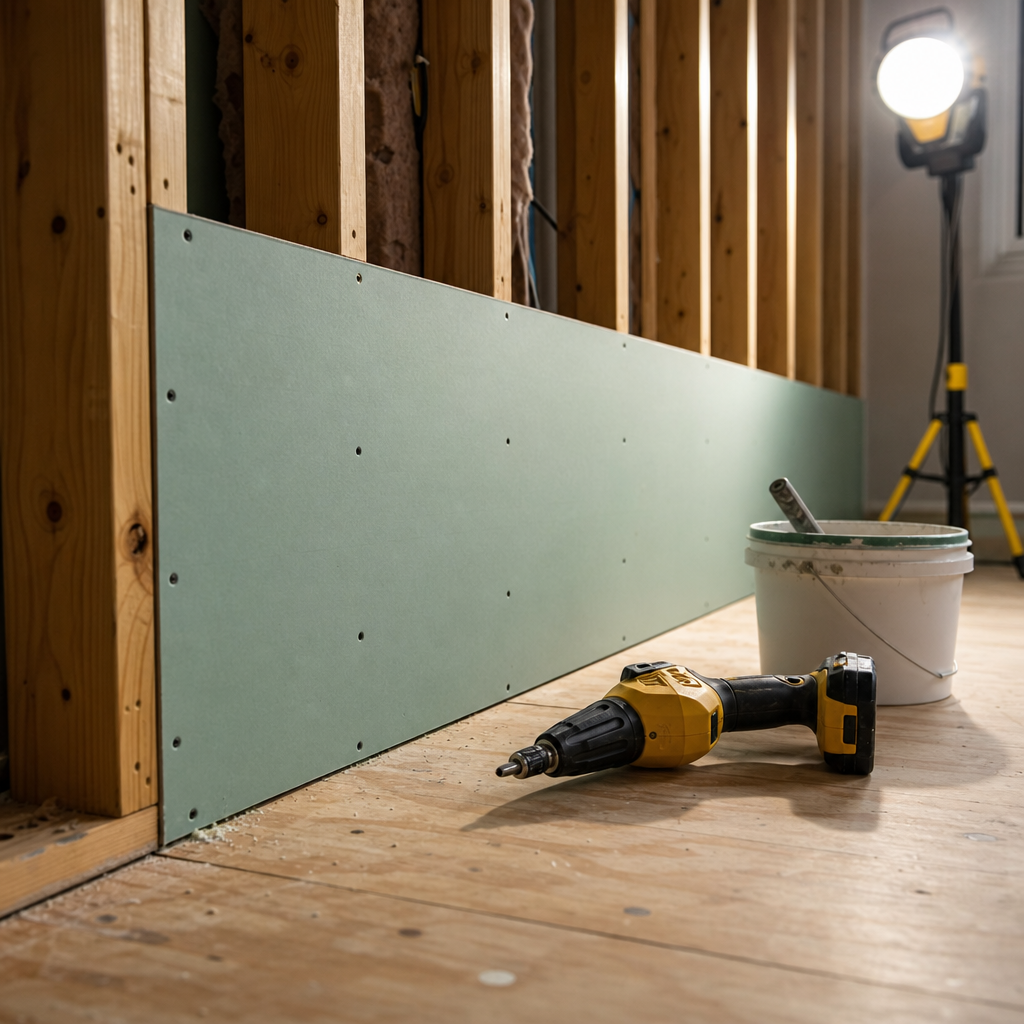
Cavity saturation occurs when water penetrates the outer wall surface and fills the interior stud bay. Even if the drywall looks salvageable on the room side, the dark, unventilated cavity inside can remain soaked, potentially affecting wood framing and insulation.
Mold Risk and Drying Timelines
Wet or damp materials should be dried within 24 to 48 hours to reduce mold risk. Wet drywall paper backing, wood studs, and dust provide an organic food source. Delaying structural drying increases project complexity and costs by turning a straightforward drywall repair into a larger remediation project.
Drying Wall Studs and Insulation
When insulation gets wet, it can compress and hold moisture directly against wood studs and masonry. Wet insulation cannot be dried effectively inside a closed wall and typically must be removed. Restoration technicians at Wade’s Restoration follow a verified sequence to restore wet cavities:
- Cut Out Damaged Sections: Cut away wet drywall and remove saturated insulation to access the cavity.
- Inspect Framing and Insulation: Check structural studs, joists, and surrounding materials for moisture retention and integrity.
- Dry the Cavity: Use commercial dehumidifiers and air movers until framing reaches safe moisture levels.
- Replace and Finish: Install new drywall, tape, apply joint compound, and finish the surface.
What Does Water Damaged Drywall Repair Cost?
Need water damaged drywall repair?
We’re available now - call for a fast, free estimate.
Water damaged drywall repair costs vary depending on the water category, total square footage, and whether structural drying and insulation removal are necessary. Simple patch repairs on dry framing are less costly, whereas extensive water intrusion requiring extraction, framing dehumidification, and multi-panel replacement increases total costs.[1]
Navigating Homeowners Insurance Claims
Most standard homeowners policies cover sudden and accidental water damage, such as a burst pipe, water heater failure, or washing machine hose rupture. Gradual leaks, neglected maintenance, and exterior floodwaters typically require separate riders or flood insurance. Proper documentation provided by Wade’s Restoration, including room-by-room photos, moisture logs, and itemized scopes of work, helps streamline insurance claims.[4]
The Professional Drywall Restoration and Reconstruction Process
Restoring water damaged drywall requires thorough structural drying before finish carpentry. Hanging new board before framing is fully dry can lead to trapped moisture, warped sheetrock, and failing finishes.[3]
- Cutting Out Damaged Sections: Technicians cut away saturated drywall above the water mark to access the damaged wall cavity.
- Inspecting Framing and Insulation: Framing and insulation are evaluated for moisture retention, structural damage, or contamination.
- Drying the Cavity: Saturated insulation is removed, and commercial drying equipment runs until moisture readings confirm the framing is dry.
- Replacing and Finishing the Area: New drywall is installed, taped, finished with joint compound, primed, and painted to complete the repair.
Frequently Asked Questions About Drywall Water Damage
How much does water damaged drywall repair cost?
Costs depend heavily on the scale of the damage, the clean-up category, and whether behind-the-wall drying and insulation replacement are required. Basic small repairs cost less, while larger projects involving structural drying and extensive drywall replacement require a larger budget.
Can you paint over water damaged drywall?
No. Painting over wet or water-stained drywall seals moisture inside the wall cavity, leading to mold growth, bubbling paint, and compromised drywall core material. Always identify the leak source, dry the interior cavity completely, replace damaged sheetrock, and prime the area with a stain-blocking primer before applying finish paint.
How quickly should wet drywall be dried to prevent mold?
Wet or damp materials should be dried within 24 to 48 hours to reduce mold risk.
How do technicians detect moisture behind pre-war plaster walls?
Visual inspections cannot reveal water trapped between lath backing and exterior brick. Restoration technicians such as those from Wade’s Restoration use non-invasive moisture meters and infrared thermal imaging cameras to map temperature and moisture differences across walls without causing unnecessary damage.
Need water damaged drywall repair?
We’re available now - call for a fast, free estimate.
Sources
- What Water Damage Costs to Fix (2026 Numbers) | Rock Bloks – rockbloks.com (2026)
- Water Damage House Repair Costs in 2026 – ibuyer.com (2026)
- Drywall Repair Cost Guide 2026: Prices by Damage Type – carolinarenew.com (2026)
- The Rising Cost of Water Damage in American Homes in 2026 – thesource.com (2026)
Related reading: Ceiling Water Damage Repair Cost | 10% Off & Free Estimate | On-Site in 60 Minutes
Related reading: Cost to Fix Water Damaged Ceiling – Call Now-10% Off – Same-Day Service – Free Estimate
Related reading: Basement Flood Cleanup Cost | Call Now-10% Off | Same-Day Service | Free Estimate
Frequently Asked Questions
How do professionals verify that framing is dry before replacing drywall?
Surface dryness does not guarantee framing is safe, as moisture easily lingers within deep wall cavities and masonry. Technicians at Wade's Restoration use non-invasive moisture meters and infrared thermal imaging cameras to verify framing is thoroughly dry before starting reconstruction. Homeowners can call Wade's Restoration to schedule a free visual inspection and thermal moisture assessment.
Why is running household fans insufficient for wet wall cavities?
Fans only evaporate moisture on the outer paint layer, leaving the interior gypsum core, wood studs, and wet insulation saturated. Trapped cavity dampness promotes hidden mold growth within 24 to 48 hours and degrades wall framing over time. Wade's Restoration removes saturated materials and uses industrial dehumidification equipment to ensure wall cavities are completely dry.
Does homeowners insurance cover water damaged drywall repair after a leak?
Most homeowners insurance policies cover drywall repairs and structural drying if the damage results from sudden, accidental incidents like burst pipes or appliance line failures. Insurers require verifiable proof of the loss, making proper moisture mapping and itemized restoration logs essential. Wade's Restoration provides detailed documentation and moisture logs to help homeowners streamline the claims process.
About the author
 |
Sarah Miller Sarah Miller is a certified water damage restoration specialist with over eight years of experience helping property owners navigate the complexities of mitigation and recovery. She holds an associate degree in Construction Management from New York City College of Technology and has extensive knowledge of local building codes and insurance claim procedures. Through her writing, Sarah provides actionable advice to help property managers and homeowners in the Astoria area understand the true costs and critical steps involved in emergency water damage restoration. |
Water damage, flood, or mold emergency?
We’re available now - call for a fast, free estimate.
Call Now - Free Estimate